
Navigating the Healthcare System
The healthcare system in Quebec is a complex entity that has been going through changes for many years, including a shift of care from hospital to community. This has changed how care is provided. Navigating the mental health system is not easy. There are challenges, but don’t despair! The information below will hopefully help you and your loved one. If you have any questions you can call us at 514-486-1448 (1-877-303-0264 outside Montreal) and we will do our best to guide you.
Looking for quick answers? Watch our short video series on Navigating the Healthcare system! Click HERE.
Please click on the links below to jump from topic to topic, or scroll down to read it all:
Hospital Services
Hospital Treatment Teams
Hospital Admissions
Rights and Recourses
CLSCs
If you have any questions about non-urgent health issues or questions about where to obtain services, dial 8-1-1 to reach Info-santé.
Hospital Services
For many years hospitals were the major source of professional help for psychiatric patients. However, it is now recognized that individuals who remain in hospital for long periods of time become “institutionalized”; they lose their social skills and their quality of life deteriorates. The government has, for the past 40 years, been gradually shifting some treatment from hospitals to community-based care.
General hospitals with psychiatry departments offer core services such as emergency, inpatient and outpatient programs. Other services vary from hospital to hospital. Psychiatric hospitals such as the Douglas only offer psychiatric services. They usually offer a wider spectrum of services, including some long-term care. For further details contact the hospital in your sector.
Emergency
In an emergency you should go to the hospital that you are closest to at the time of the crisis. (At other times it is best to go to the hospital closest to your home, although you do have the right to go to the hospital of your choice under Quebec law, on condition that the desired services are available.)
Anybody undergoing a psychiatric crisis should present himself at emergency. In general hospitals there is one emergency room for both physical and psychiatric crises. Typically, people are first seen by a general physician to verify that there is no physical cause for the crisis. They are then referred to the psychiatrist on call. The psychiatrist conducts an evaluation, and then proposes a treatment plan. The plan may include a stay in the hospital ER for further observation, a stay in the inpatient ward or discharge with a treatment plan. A violent or overly distraught patient can be given medications without his consent if there is a risk to his or another person’s safety. If he represents a severe danger to himself or others and refuses to stay on his own accord, the psychiatrist may keep him in hospital against his will.
Crisis intervention is a service offered to people who visit the ER during a crisis. If the person is not a psychiatric patient at the hospital and is not stable enough to be treated in the community, the crisis team may provide short-term follow-up (average three months). During this time the psychiatrist or team member helps the person cope with the crisis as well as any accompanying social and situational stresses. Often, the psychiatrist prescribes medications and a team member provides psychotherapy. After the 3-month period, the person is either referred to a psychiatrist in the hospital for longer-term follow-up or is referred back to his treating doctor in the community.
Inpatient
Inpatient services offer a structured environment where acutely ill patients can be closely monitored in the hospital in order to establish a diagnosis and implement an acute-care plan designed to control their symptoms and stabilize their illness.
Patients who are acutely ill may be placed in psychiatric intensive care or high care, which is a closed or locked unit. They may be psychotic, dangerously depressed, or suicidal and may require this level of care for their own protection. They are closely observed and their illness managed with medications.
Brief therapy offers observation, diagnosis and treatment of a wide variety of severe psychiatric problems. This therapy deals with the management of severe mood disorders, the investigation and treatment of pathological aggression, and treatments such as electroconvulsive therapy (ECT) for acute or chronic illness that is resistant to medication.
Along with general psychiatric services, some hospitals also provide specialized services for addictions, detoxification and rehabilitation, anxiety, and eating disorders.
Outpatient and External Services
After treatment in a hospital, or after an assessment by the ER psychiatrist, outpatient or follow-up services are usually arranged. All hospitals have these services, which include assessments, follow-up of patients discharged from the ward or ER, outpatient clinics for people requiring long-term follow-up and often day programs. Some outpatient departments also offer specialized services for particular conditions such as Tourette’s Syndrome, sexual dysfunction, gender orientation difficulties, or substance abuse.
Day treatment programs can include transitional day programs (for people coming from an inpatient ward), day hospitals (intensive day program), rehabilitation day centres (a focus on rehabilitation) and acute-care day programs (for those too sick for regular follow-up and unable to participate in an intensive day program).
Some hospitals have an Assertive Community Treatment program (ACT) or a Community Link program that offers severely ill patients follow-up in their home or elsewhere in the community. Most of these patients would otherwise require frequent hospitalizations.
Hospital Family Support Groups
Psychiatry departments in some hospitals offer support and education to families. If you want to know whether this is available at your hospital, ask your relative’s treatment team.
Hospital Treatment Teams
Psychiatrists are medical specialists with expertise in evaluating, diagnosing and treating persons with a psychiatric problem. Their primary role is to stabilize and maintain their patients with medication and therapy. They may also act as consultants to general practitioners or follow patients with them in a “shared care” fashion.
Psychiatric nurses work in close collaboration with psychiatrists to develop a treatment plan for the patient. Psychiatric nurses frequently work as the “case manager”, and assist in connecting patients with appropriate services. They act as educators, therapists and may also regulate medications.
Social workers commonly serve as the liaison between the institution, the family and community resources. They make follow-up and housing arrangements for clients and arrange appropriate day programs. They may provide individual and/or group therapy either in hospital outpatient clinics or private practice. To arrange for social worker assistance, you must ask your relative’s doctor or make a request at the Social Services department in the hospital.
Clinical psychologists conduct psychological evaluations through interviews and tests. They offer counselling or therapy for the purposes of education, rehabilitation, and alleviation of symptoms.
Occupational therapists (OT) assess a person’s functional and relational skills in organizing his daily activities. The OT’s role is designed to facilitate the person’s transition into the community through adaptation and rehabilitation. Their goal is to assist patients in achieving their maximum potential.
Orientation and rehabilitation counsellors evaluate a person’s skills, interests and occupational capabilities. They encourage the development of greater autonomy by helping the person readapt on a personal, educational, and professional level. They work with community and institutional resources to develop rehabilitation programs tailored to each individual’s needs.
Treatment team / community partnerships Hospital teams sometimes use the services of orientation counsellors from community resources to develop aftercare programs for individuals. Some hospitals also offer classes taught by teachers from the adult-education division of school boards specialized in working with psychiatric populations.
Hospital Admissions
Voluntary Admissions
A person in crisis can go to the emergency room. You may wish to call the hospital beforehand. Hospital admissions are generally handled through hospital emergency services. Voluntary admission for someone new to the psychiatric network must go through the hospital’s general emergency. Sometimes the family doctor is helpful in facilitating matters.
Admission of someone already known to, and followed by, the outpatient clinic may be arranged by the outpatient medical team. However, if a crisis occurs outside of office hours, the person must go through the emergency department.
Involuntary Admission (court order)
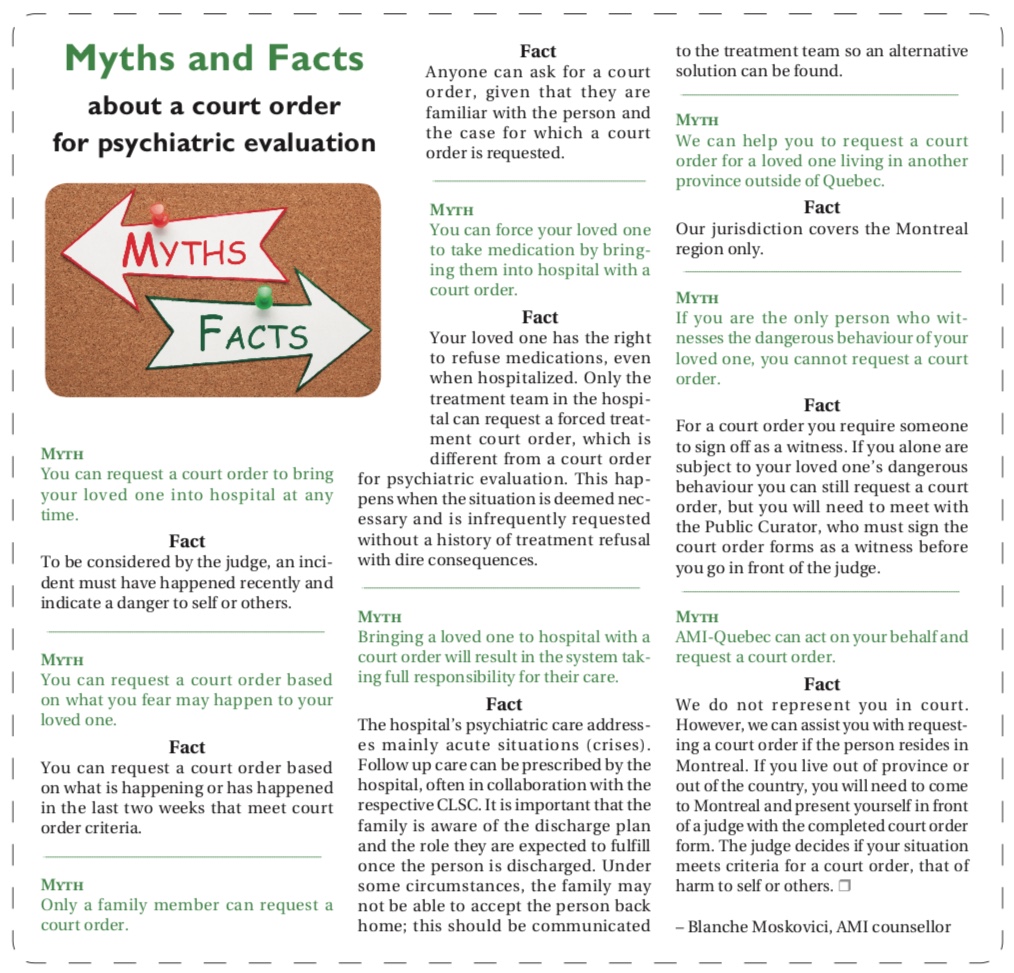
What can you do when your ill loved one needs psychiatric help but refuses? At AMI, we can help you explore options. A last resort is a court order for psychiatric evaluation.
A court order is a legal procedure that may be required when someone poses a risk to themselves and/or to others, but refuses help. Upon request by an interested party (family or other), the court can grant a time-limited order for a psychiatric assessment.
There are 3 types of court orders that may be of interest to family caregivers struggling to help a loved one suffering from mental illness:
- Court order for psychiatric evaluation (requested by the family or another interested party).
- Court order to keep the person in the hospital (requested by the hospital, limited for up to 21 days, and can be renewed).
- Court order to force treatment (requested by the treatment team; a judge decides the length of time a patient must submit to forced treatment).
The following refers to the first type of court order for a psychiatric evaluation. Information about the other two can be found by clicking here.
It is always better to encourage the ill person to go to the hospital voluntarily. However, a person may not understand he needs help and it is not always possible to convince him. If he is already being followed by a psychiatrist or other mental health professionals, you may ask for assistance in trying to convince him to enter the hospital voluntarily. If he still refuses, those close to the person and aware of the situation (family, friend, practitioner) can consider whether to ask the court an order for an involuntary psychiatric assessment.
Involuntary admissions are guided by the Mental Patients Protection Act (Loi P-38.001). This Quebec law restricts involuntary confinement in an institution to cases where a person presents a danger to themselves and/or to others.
In case of immediate danger, call 911 and state there is a psychiatric emergency. Upon arrival, the police will assess the situation. If they judge that the person requires an urgent psychiatric assessment in the hospital, they will call Urgences Santé for transportation to the hospital.
If the police decide that there is no immediate crisis requiring hospitalization, but you still think your relative poses a danger to himself and/or others, you can fill out a court order request for involuntary psychiatric assessment. The request must be completed by an applicant and a witness who can testify to the person’s acute, dangerous situation. Note that such a court order is not designed to treat anyone against their will but rather to have them assessed in the hospital.
Court order forms can be obtained at your local CLSC or family association, where assistance in filling it out may also be provided. Court orders can be requested at the Palais de Justice every day during office hours. A same-day appointment can be made if you call in the morning.
Court Locations
Montreal
Palais de Justice
1, rue Notre Dame Est
Montreal, Quebec H2Y 1B6
Tel. 514-393-2721
Laval
Palais de Justice de Laval
2800 boul. Saint-Martin O.
Laval, Quebec H7T 2S9
Tel. 450-686-5001
After the court decision
If a court order has been granted, the requesting party must bring the signed form as soon as possible to the police station nearest the ill person’s residence. The police will call an ambulance to escort the individual to the designated hospital. If the individual has fled or cannot be found, the police will open a file. The court order will remain valid until the individual is located.
Once in hospital, the person must be examined by two psychiatrists within a period of 24 hours. Upon evaluation, the psychiatrists will decide whether the person meets the criterion of grave and immediate danger and will either release or retain him for further observation. If they decide to keep him, a second court order requesting to keep the person in the hospital must be completed within 96 hours. If granted by the court, the confinement is limited to up to 21 days. That court order may be lifted at any time during this period if the individual no longer presents a danger. While this court order gives the hospital the right to retain the patient, it does not give the right to administer treatment without the person’s consent.
Pros:
A court order is a last resort option when someone presents a danger to themselves (e.g., suicide attempt or ideation) or a danger to others (e.g., homicidal). It is used with discretion to ensure the safety and well-being of your loved one in the present moment, by providing care and preventing escalation.
If your loved one is experiencing a mental health crisis for the first time, getting them stabilized as soon as possible is best for their well-being and recovery.
Cons:
If you bring your loved one into hospital with a court order, your loved one may feel betrayed, despite your best intentions. If the person can present themselves well, they may be able to talk their way into being discharged soon after they are brought to the hospital. The family then will need to deal with the potential backlash of anger from their loved one.
Note: Families often view a court order as a solution for difficult situations. This is seldom the case! While a court order is necessary at times, it is preferable to address any challenges amicably, without the need to resort to the court. Once a court order is ‘exhausted’ (the person is released), it is often back to square one, where the family needs to deal with the same problems, plus the possible resentment of their loved one.
Rights and Recourses
The Quebec Charter of Human Rights and Freedoms guarantees each person the right to dignity and respect for private life and protects him from discrimination and exploitation (Health and Social Services Act, sec. 9).
Treatment Rights
According to the Charter, a sick person has the right to accept or refuse treatment, either totally or in part. This is called the right to consent to treatment. “No one may be given care without their informed consent. A person recognized as being able to give free and informed consent may thus refuse surgery that could save his life. While in some circumstances such a decision may seem to run counter to common sense, this right must nevertheless be respected by health professionals.”
The situation is different if the person is considered unable to consent or refuse the care required by his state of health. In such a case the hospital will seek to obtain the consent of a legally authorized person – the mandatory, tutor, curator, spouse, close relative, or person who shows a special interest in the person of full age (Civil Code, art. 15). The same procedure can be used when a person of full age categorically refuses care even if he has been declared inept or incapable (Civil Code, art. 16).
The right to accept or refuse treatment also includes a right to receive adequate information so that the choice is meaningful. This right is known as “informed consent” or “consentement éclairé.” The information provided should include the nature and goals of the treatment, its effects, the procedures used, the possible risks and side effects, viable alternatives and their respective risks, as well as the expected consequences of a refusal or non-intervention.
In the case of a person who is unable to consent, a representative is entitled to the same right to information concerning treatment. This is your right: don’t be afraid to ask questions.
People who have been admitted voluntarily have a right to leave the hospital whenever they choose, even though this may be against medical advice.
Rights of the Hospitalized Individual
Though a person admitted under confinement is deprived of his freedom, he nevertheless retains all his legal rights. These rights are guaranteed in the Mental Health Protection Act, Loi P-38.001, which also guarantees access to a lawyer and provides for written notification and legal recourse for the patient.
As previously stated, even if a person is under confinement in an institution, he has the right to refuse treatment, in whole or in part, unless he has been declared incapable of consent. “Any person who is dissatisfied with a decision rendered under this act with regards to himself or anyone related or allied to him may request the Commission des Affaires Sociales to review the decision” (M.P.P.A., s. 30.)
The decision of confinement in an institution may be contested at any point by a written request explaining the person’s or the third party’s dissatisfaction. When placed under confinement in an institution, the patient receives information about how to launch such proceedings.
No hospital may confine a person for more than 21 days without a new examination by two psychiatrists confirming the necessity for continued confinement. Another examination must be performed after three months and every six months thereafter.
The person has the right to an exchange of confidential correspondence with certain people: a lawyer, a notary, the Public Curator, the Commission des Affaires Sociales, a member of the National Assembly, a doctor, the protecteur du citoyen, the institution, the Régie Régionale and the Complaints Commissioner.
Right to Access to Information
The Health and Social Services Act guarantees (R.S.Q., c.42) access to information. A person may be allowed to consult his own medical file unless it contains certain information that would harm him to know. It is also possible to have certain facts corrected in the medical file. All medical reports and files remain confidential. This means that if the person does not want his family to see his medical files, they cannot access them. The right to confidentiality applies to everyone including those admitted under confinement in an institution.
The law also recognizes that each person has the right to choose the professional he deals with or the institution where he receives treatment or social services. This right is nonetheless subject to the institution’s constraints regarding its organization, operations and resources. Except in the case of an emergency, a professional also has the right to accept or refuse to treat a patient.
Right to Services in English
All emergency services must be able to assist English-speaking people. In Montreal, certain institutions are specifically designated, or specific services in other institutions are indicated to provide non-emergency services to English speaking clients. These designations have been made by the Ministry of Health and Social Services and are found in the Montreal Regional Access Plan. The Montreal plan and all other regional access plans are available for viewing at www.chssn.org. It is also possible to obtain the services of an interpreter if the patient speaks another language.
Quebec’s Act Respecting Health Services and Social Services states:
“English-speaking persons are entitled to receive health services and social services in the English language, in keeping with the organizational structure and human, material and financial resources of the institutions providing such services and to the extent provided by an access program referred to in section 348.”
Section 348: “Each agency, in collaboration with institutions, must develop a program of access to health services and social services in the English language for the English-speaking population of its area in the centres operated by the institutions of its region that it indicates or, as the case may be, develop jointly, with other agencies, such a program in centres operated by the institutions of another region…”
Right to Agree or Refuse to Participate in Research
People have the right to agree or refuse to participate in a scientific research program or an education project. As in treatment, if the person is incapable of consenting to research or education, another person who is authorized by law may do so, provided the study involves a minimum risk or inconvenience. A court can give its authorization under certain conditions in the absence of a representative.
Right to Lodge a Complaint
In every hospital, you may obtain information regarding the rights of users and the complaints examination procedure from the ombudsperson. Psychiatric institutions must have a user committee to help their patients and assist them in their attempts to defend their rights (visit the Legal section of our resource list by clicking HERE).
Click here for the user committees in the CIUSSS Centre Ouest.
This does not mean that a user cannot select a person of his own choice to help him defend his rights. Family support organizations and self-help groups play a key role in endorsing the rights of the mentally ill and providing vital information.
Quebec Healthcare System
Since the introduction of Bill 10 in 2015, Quebec’s Healthcare and Social Services System has been organized into 22 regional agencies. The regional institutions are called Integrated Health and Social Service Centers (CISSS) or Integrated University Health and Social Service Centres (CIUSSS).
The CISSS/CIUSSS serve as reference points where people can receive services or be directed to other centres when experiencing health-related and psychosocial problems. The CISSS/CIUSSS of each region is responsible for managing and coordinating social and health services for the community it serves. These regional agencies deliver services to the public through institutions listed below.
- Hospital Centers (CH): Provide diagnostic services, general, and specialized medical care, nursing care, specialized psychosocial services, preventative services, and rehabilitation services.
- Residential and Extended Long-term Care Centers (CHSLD): Offer adults experiencing a functional or psychosocial difficulties a substitute living environment and various services, including housing, assistance, range of medical support services (eg. psychosocial, nursing, pharmaceutical), and rehabilitation.
- Local Community Service Centers (CLSC): Offer preventative, curative, and rehabilitation services in the community.
- Child and Youth Protection Centers (CPEJ): Offer youth and families psychosocial services, child placement and family mediation services, and other services relating to parenting.
- Rehabilitation Centers (CR): Offer rehabilitation services at healthcare institutions (in- or out-patient) or in the home.
In Montreal there are 5 CIUSSS that overlook the island’s hospitals, CLSCs, and long-term care facilities.
CLSCs (Local Community Service Centres)
The CLSC is the frontline health and social services institution in your neighbourhood. It is a place where you or your family member can find health and psychosocial services or be directed to other community resources that meet your needs. To find your local CIUSSS, which will direct you to your local CLSC, click HERE.
All CLSCs have an Info-Santé service available 24 hours a day, 7 days a week. You can reach a nurse by dialling 811. Info-Santé is there to answer questions you may have before going to a hospital or clinic. By calling 811, you can also reach a social worker who can help you through a difficult situation.
As a minimum, all CLSCs offer prevention and basic mental health services for people with mental health problems. They can also offer help for those with severe or persistent mental illness. A home-care psychogeriatric service is also available at most CLSCs.
CLSCs try to tailor their services to the specific needs and culture of their local population. As the organization of services varies from one CLSC to the next, do not hesitate to contact your local centre for more information.
Mental Health Action Plan (2015-2020)
The 2015-2020 Mental Health Action Plan (PASM) was launched in 2015 under the slogan “Faire ensemble et autrement” (Working together in a new way). The new action plan works on developing and implementing first-line mental health services as well as follow-up support in the community. It plans to focus on improving services such that the allocation of available, limited resources are effective, efficient, and promising to the diverse needs of the users.
The four major components of the 2015-2020 PASM are to:
- respect the rights of citizens with mental health problems
- provide care and services adapted to young people, from birth to adulthood
- Implement clinical and management practices to improve care
- Continuously improve the quality and delivery of mental health care and services
In line with the previous action plan, the PASM 2015-2020 emphasizes that a recovery-oriented approach be taken by mental health services such that the focus is on an individual’s strengths, promoting a sense of hope, and supporting meaningful participation in society. The new PASM also calls for organizational action to promote workplace mental health.
Sign up for our emails to stay in touch
Please also follow us on: